
Timnath News
Inform yourself of development proposals throughout Timnath. Get involved in project considerations and decision-making processes as they journey through the Town of Timnath development process. Together we can guide thoughtful growth in our town.
Timnath News » Land Use »
Timnath Proposes Land Use Code Changes

MEMORANDUM
TO: Members of Planning Commission
FROM: Logan Graves, Community Development
DATE: November 11, 2024
SUBJECT: Land Development Code Amendments
Purpose:
The Community Development Staff has identified a list of 33 potential amendments to the Town’s Land Use Code over the past year. These amendments have been gathered from various sources to address gaps, enhance consistency, and ensure alignment with evolving standards and priorities. Attachment A includes a description of the potential amendments.
This memo outlines the prioritization process and presents a recommended strategy and timeline for implementing the proposed amendments to the Town’s Land Use Code. Following input from the Planning Commission and an internal staff review, the amendments are organized by priority and staff time requirements to establish an implementation schedule.
Methodology for Prioritization
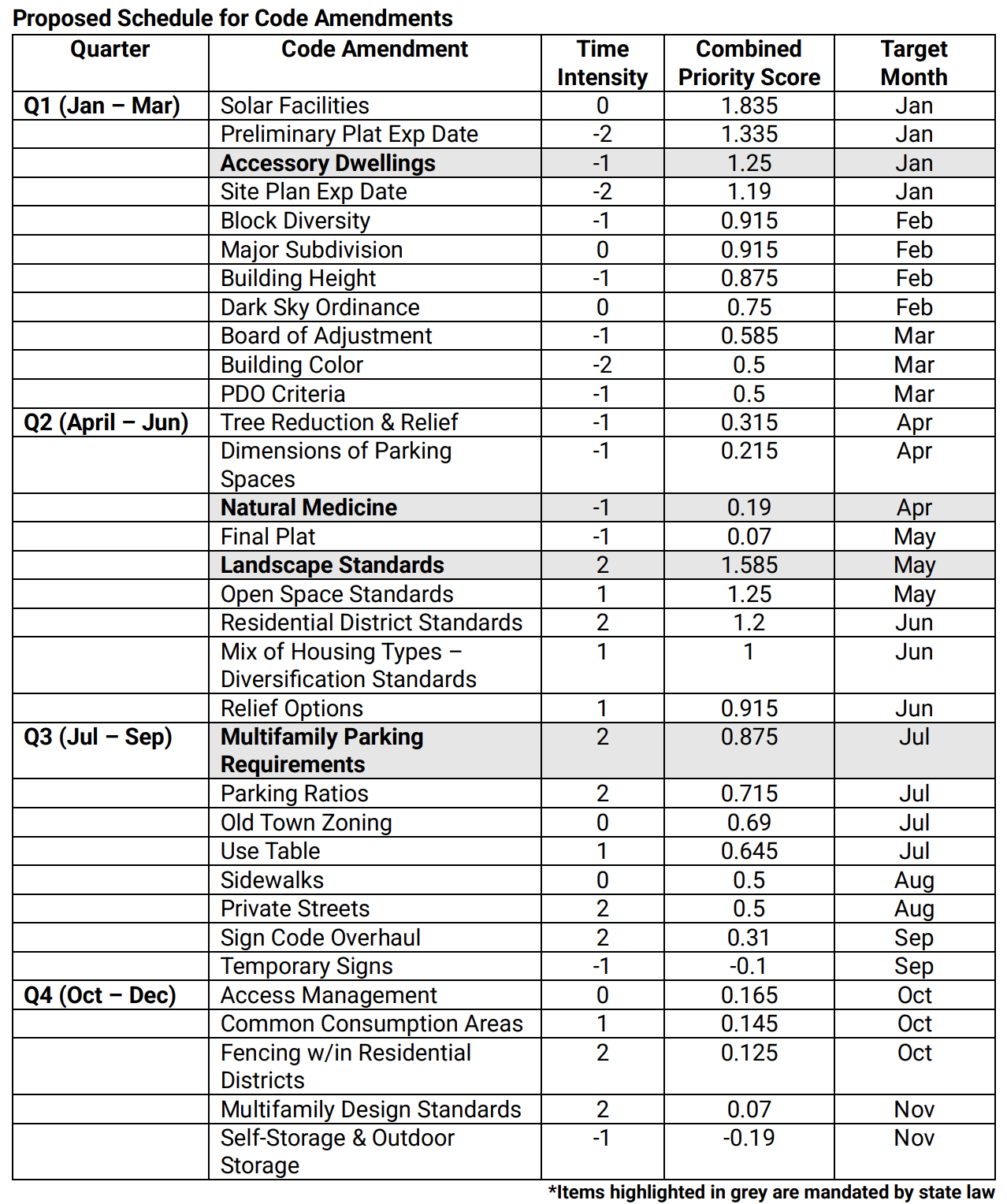
The amendments were prioritized by assigning each item a Time Intensity Rating and an
Effectiveness Rating as detailed below. The Time Intensity Rating is a preliminary assessment of an amendment’s overall level of complexity based on its impact on existing code sections, the need for new regulatory frameworks, and the likelihood of legal review. The Effectiveness Rating gauges the amendment’s potential to improve code functionality and clarity. Feedback from the Planning Commissionn’s survey was incorporated with staffs priority ranking to develop a combined priority score.
As work progresses, these ratings may be refined based on additional staff analysis and Town Attorney recommendations. Some amendments, though they may appear straightforward, involve potential trade-offs that will be assessed throughout the amendment process. To maintain transparency, staff is committed to engaging stakeholders and ensuring that those impacted by these updates are informed and have opportunities for input.
Time Intensity Rating (X-axis): This metric gauges the estimated effort required for each amendment, with negative values indicating lower time commitments:
- -2 (Minimal Staff Time): Requires less than 8 hours; consent agenda approval recommended.
- -1 (Low Staff Effort): Requires 8-24 hours; likely involves one Town Council meeting.
- 0 (Moderate Staff Effort): Requires 24-48 hours, with some consultant or stakeholder input.
- 1 (High Staff Effort): Requires more than 48 hours and the potential for a work session.
- 2 (Intensive Staff Effort): Involves over 48 hours, extensive reviews, and multiple Council meetings.
Effectiveness Rating (Y-axis): The Planning Commission and Staff rated the importance of each amendment, with ratings indicating urgency and potential impact on town planning goals:
- -2 (Minimal Priority): Negligible impact; deferrable.
- -1 (Low Priority): Some improvement but limited long-term impact.
- 0 (Medium Priority): Moderate impact, aligns with the Comprehensive Plan.
- 1 (High Priority): Substantial positive impact and alignment with the Comprehensive Plan.
- 2 (Critical Priority): Urgent and impactful, potentially mandated by state law.
To calculate the Combined Priority Score, we averaged Planning Commission responses and staff ratings, representing the consensus view on each amendment’s importance and implementation need.
Quadrant Classification
The amendments were categorized into four quadrants on a scatter plot, providing a visual ranking to guide prioritization:
- Top Left (High Priority, Low Effort): Highest priority items for immediate action.
- Top Right (High Priority, High Effort): Important but resource-intensive; second-tier priority.
- Bottom Left (Low Priority, Low Effort): Lower priority, but easy to implement.
- Bottom Right (Low Priority, High Effort): Least urgent items requiring significant resources.

Recommended Timeline for Implementation Staff
recommends implementing amendments quarterly, focusing first on items that are high priority with low effort. This approach allows manageable progress across the year while balancing resource allocation. A more detailed schedule is provided in Attachment B.
Conclusion
This prioritized, phased approach enables a manageable schedule for implementing Land Use Code amendments throughout the year. Items are categorized based on their impact and staff effort required, aiming to address high-priority and low-effort items first. The proposed schedule is ambitious, and timelines may be adjusted as necessary to accommodate workload and unforeseen delays.

 Website Design & Web Hosting